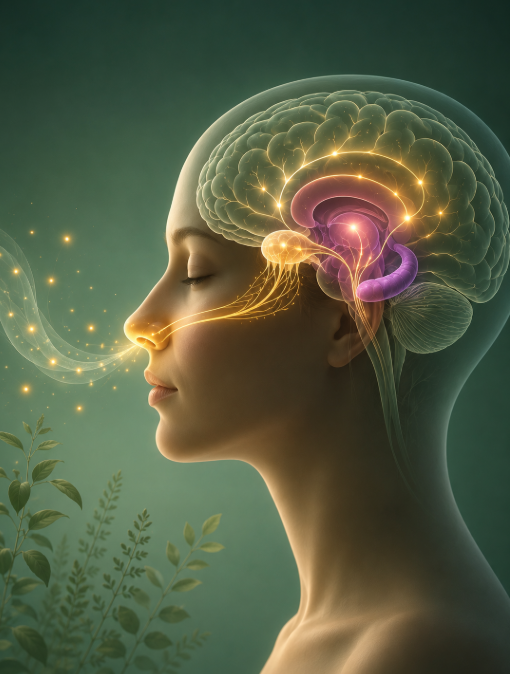
Of all our senses, smell has a unique neuroanatomy: olfactory signals travel via the olfactory bulb to regions of the brain involved in emotion and memory without first being routed through the thalamus, which handles most other sensory input. This anatomical detail is often cited as part of the foundation for aromatherapy's reported effects on mood, memory, and stress response.
This article gives a plain-English overview of how the olfactory system connects to the brain, the proposed mechanisms researchers are studying, and the limits of what current evidence tells us. It is educational information, not medical advice.
The Olfactory Pathway: Scent's Direct Route to the Brain
When you inhale aromatic molecules from high-quality essential oils, a complex neurological cascade begins within milliseconds:
The Olfactory-Limbic Pathway
Unlike all other senses, smell bypasses the thalamic relay and connects directly to the limbic system — explaining its immediate emotional and physiological impact.
The olfactory receptor neurons in your nasal cavity project directly to the olfactory bulb, which connects without thalamic intermediary to three key limbic structures:
- The amygdala — processes emotional responses, fear conditioning, and fight-or-flight
- The hippocampus — consolidates memory formation and contextual learning
- The hypothalamus — regulates the HPA (hypothalamic-pituitary-adrenal) axis and cortisol release
Molecular Mechanisms of Aromatic Compounds
Beyond the olfactory pathway, many volatile compounds from pure essential oils exert direct neurological effects through receptor binding and enzyme modulation:
Linalool (Lavender) — Reported Activity at GABA-A and 5-HT1A Receptors
Linalool, a primary aromatic constituent of lavender, has been studied in animal and human research for possible interactions with the central nervous system. Some published reviews discuss effects on GABA-A receptors; others emphasize serotonergic (5-HT1A) pathways. The dominant mechanism is still debated and findings vary. Linalool is not a medication and is not a substitute for clinically prescribed anxiety or sleep treatments.
Citrus Aromatic Compounds (Bergamot, Lemon)
Citrus essential oils, including bergamot and lemon, contain limonene and linalyl acetate. These compounds have been investigated in some studies for possible effects on mood and the serotonergic system. Findings are mixed and effect sizes vary by study and method.
1,8-Cineole (Rosemary, Eucalyptus) — Reported Cognitive Effects
1,8-Cineole, a constituent of rosemary and eucalyptus essential oils, has been studied for possible effects on attention and working memory. Some small studies have reported short-term improvements in task performance during inhalation; results are not consistent across all research.
HPA Axis & Cortisol
Researchers have measured salivary cortisol levels before and after aromatherapy interventions in some studies. Reports for oils such as lavender, bergamot, and ylang ylang are mixed — some find reductions in cortisol compared to controls; others find no significant change. More high-quality research is needed.
Scent & Memory: The Proustian Effect
The hippocampus's direct connection to the olfactory bulb explains the powerful autobiographical memory associations triggered by scent — the "Proustian effect," named after Marcel Proust's famous description of involuntary memory evoked by the smell of a madeleine dipped in tea.
Clinically, this scent-memory link has therapeutic applications:
- Consistent use of specific scents during relaxation or sleep can create conditioned associations, making those smells effective anxiolytics even in stressful contexts
- Aromatherapy is being investigated in Alzheimer's disease for its ability to stimulate autobiographical memory retrieval via preserved olfactory-hippocampal pathways
- Context-dependent memory studies show that scent during learning improves recall — relevant for educational aromatherapy applications
EEG Research
Some studies using electroencephalography (EEG) have reported short-term brainwave changes during essential oil inhalation. Findings vary by oil, dose, study design, and participants. A few examples from the literature:
- Lavender: Some studies report shifts in alpha and beta wave activity associated with relaxation, with mixed results across populations.
- Rosemary: Some small studies report shifts associated with alertness during inhalation.
- Peppermint: Some small studies report shifts associated with attention and task performance.
These findings are preliminary and should not be generalized as definitive evidence of clinical effect.
Systemic Absorption: Beyond the Nose
In addition to neurological effects via the olfactory pathway, some aromatic compounds are absorbed transdermally and pulmonarily, reaching systemic circulation. Studies have detected linalool, 1,8-cineole, and limonene in blood plasma within minutes of inhalation or topical application of high-quality essential oils.
Plasma levels achieved are generally sub-pharmacological (below conventional drug doses), but may still contribute to physiological effects in concert with the neurologically-mediated pathway.
Practical Considerations
- The basics are real: Smell is a well-studied sense with direct connections to brain regions involved in emotion and memory. How much of any given aromatherapy effect is due to the chemistry vs. the experience of the scent is still an active area of research.
- Real aromatic compounds matter: The olfactory pathway responds to actual volatile compounds. Real essential oils contain a different profile than synthetic fragrance products — what that means for any specific health outcome is more nuanced.
- Individual differences: People perceive scents differently due to genetics, expectation, and context — which is part of why aromatherapy research often shows variable results.
- Anosmia: Anyone who has lost their sense of smell may not experience inhalation-based aromatherapy in the same way as others.
This article is a plain-English introduction to a complex and still-developing research area. It is not medical advice and is not a substitute for guidance from a qualified healthcare provider.
Essential oils are not intended to diagnose, treat, cure, or prevent any disease.